
India’s coastline stretches over 7,500 kilometres. It borders three seas and holds a near-unlimited source of water, most of which is too salty to drink, irrigate with, or use in industry.
That gap between abundant seawater and usable freshwater is exactly what a seawater membrane solves.
Modern seawater reverse osmosis (SWRO) technology has moved from an engineering curiosity to a mainstream solution across India’s coastal states. Mumbai’s refineries, Chennai’s municipalities, Gujarat’s chemical clusters, and island communities in Lakshadweep now depend on it. Moreover, as India’s freshwater stress deepens, demand for proven, high-performance seawater membranes is only going in one direction.
This guide breaks down how seawater membranes work, the main types, what the data says about India’s desalination market, how to compare seawater and brackish membranes, and exactly what to look for when buying.
India’s Desalination Market: Why This Matters Right Now?
Before we get into the technology, context matters.
India’s desalination market was valued at USD 1,046.7 million (approximately ₹8,700 crore) in 2025, and is projected to grow at a CAGR of 8.85% through 2034, reaching USD 2,295.9 million (IMARC Group, 2025).
Seawater is already the dominant feedstock, accounting for 71.58% of India’s desalination market in 2025 (Mordor Intelligence, 2025).
India’s total desalination capacity currently exceeds 620 million litres per day (MLD), with around 31 new municipal and industrial plants, totalling approximately 1,800 MLD, expected to come online by 2026 (India Infrastructure Research). Tamil Nadu and Gujarat lead the pipeline, driven by upcoming power plants, refineries, and municipal demand.
The upcoming Perur Desalination Plant in Tamil Nadu is set to become Southeast Asia’s largest, with a target capacity of 400 MLD (Blackridge Research).
For industries and plant designers evaluating a seawater membrane system today, the timing is right. Infrastructure is maturing, membrane technology is advancing, and the cost-per-m³ of treated water continues to fall.
What Is a Seawater Membrane?
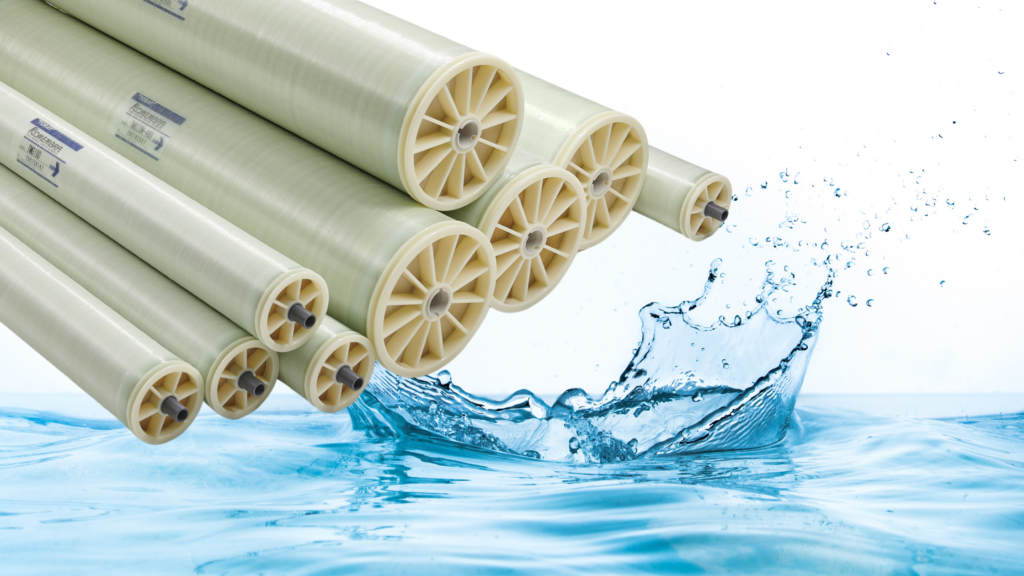
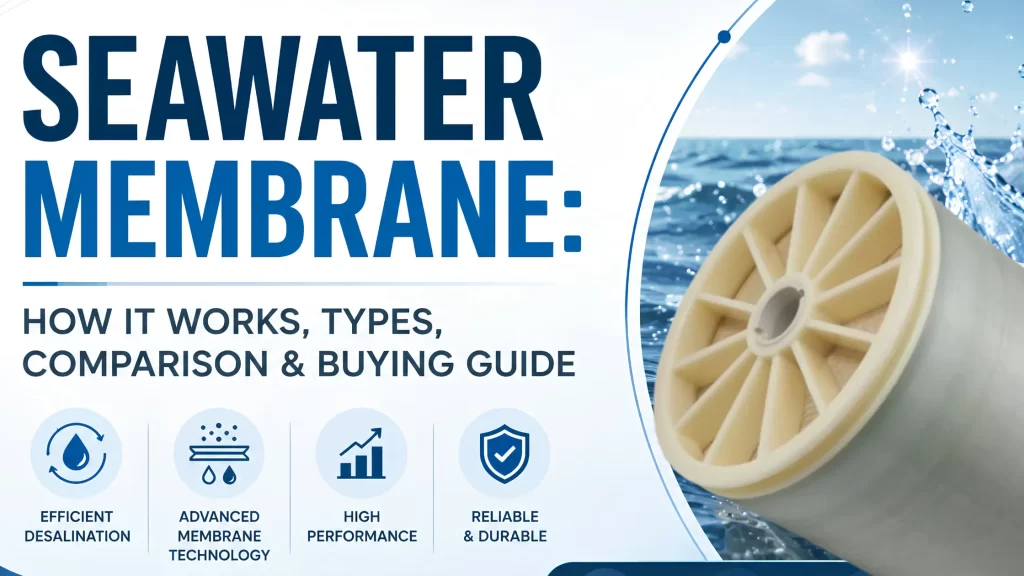
A seawater membrane is a semipermeable synthetic sheet engineered to allow water molecules to pass while blocking dissolved salts, microorganisms, and most other contaminants found in open seawater (Veolia Water Technologies).
In a seawater reverse osmosis system, these membranes are housed in high-pressure cylindrical vessels. Pressurised seawater flows across the membrane surface; fresh permeate passes through, while concentrated brine exits from the other end.
The core separation layer in modern SWRO membranes is a thin-film composite of aromatic polyamide, typically less than 200 nanometres thick. This layer achieves the salt rejection; a polysulfone support layer and a polyester backing provide mechanical strength.
High-quality seawater membranes achieve ≥99% salt rejection under standard test conditions (ScienceDirect), making the permeate suitable for drinking and industrial use after post-treatment.
How a Seawater Membrane Works (Step by Step)
At its core, seawater reverse osmosis simply reverses the natural direction of osmosis using pressure.
In natural osmosis, water moves from a less concentrated solution to a more concentrated one across a semipermeable membrane. SWRO applies sufficient pressure to overcome the osmotic pressure of seawater, typically 55-68 bar (800–1,000 psi), forcing water in the opposite direction: from the salty side to the fresh side.
Here is what happens inside a complete SWRO system:
Step 1: Seawater Intake and Pre-Treatment
Seawater is drawn from the ocean through beach wells or open-sea intakes. Before it reaches the membrane, it undergoes screening, multimedia filtration, and, often, ultrafiltration (UF) pre-treatment to remove suspended solids, silt, algae, and larger particles. Proper pre-treatment is not optional; it directly determines how long the seawater membrane lasts and how often it needs cleaning.
At Jay Water, ultrafiltration membranes are commonly recommended as pre-treatment ahead of SWRO, particularly for coastal intakes with high biological or turbidity loads.
Step 2: Antiscalant Dosing
Before the pressurised feed reaches the membranes, antiscalant chemicals are dosed into the feedwater to prevent scaling from carbonates, sulfates, and silica on membrane surfaces. For SWRO applications specifically, ROPUR RPI-2800 is engineered for high-salinity seawater environments, preventing both carbonate and sulfate scaling while reducing biofouling in operating plants.
Correct antiscalant dosing (typically 5–20 ppm) protects membranes, extends cleaning intervals, and significantly reduces operational cost over the plant’s life.
Step 3: High-Pressure Pumping
A high-pressure pump raises the feedwater pressure above its osmotic pressure. Modern plants pair this with energy recovery devices (ERDs), typically pressure exchangers that capture energy from the high-pressure brine reject stream and return it to the feed, significantly reducing energy consumption.
State-of-the-art large SWRO plants with ERDs now achieve a specific energy consumption (SEC) as low as 2.8 kWh/m³, compared to the earlier industry range of 4–6 kWh/m³ (ScienceDirect, 2025). The typical operating range for well-designed SWRO plants is 2.0–5.5 kWh/m³, depending on salinity, recovery, and ERD type.
Step 4: Separation Inside the Membrane Element
The seawater membrane element is a spiral-wound construction: flat membrane sheets are wound around a central permeate-collection tube, separated by mesh spacers. Feedwater flows axially along the element; water molecules pass radially through the polyamide layer into the centre tube as permeate, while salts and impurities are carried out as brine.
A single 8-inch Toray seawater membrane element can handle feed salinities above 10,000 ppm and produce several cubic meters of treated water per day. In large SWRO plants, thousands of elements are stacked in series and parallel arrays to reach the target daily output (Toray Membranes, via Jay Water).
Step 5: Post-Treatment and Distribution
The permeate leaving the membranes is typically low in minerals and slightly acidic. Post-treatment remineralisation, pH correction, and disinfection bring it into compliance with drinking water standards.
For Indian plants supplying municipal networks, the treated water must meet BIS IS 10500:2012 limits covering TDS, chloride, nitrate, fluoride, and zero detectable coliforms in 100 mL (Bureau of Indian Standards summary via AWT). The concentrated brine is handled separately in accordance with applicable environmental regulations.
Types of Seawater RO Membranes
Not all seawater membranes are identical. Manufacturers design different product families for different salinity levels, temperatures, fouling risks, and energy targets.
High-Rejection Seawater Membranes
Designed for salt rejection above 99.7%, these are used where feed TDS is very high or where post-treatment is minimal. They typically operate at slightly higher pressures to achieve their rejection performance. Ideal for offshore platforms, island systems, and municipal supply where permeate quality is the primary concern.
Low-Energy / Low-Pressure Seawater Membranes
These membranes deliver acceptable salt rejection at lower operating pressures, reducing energy consumption per cubic meter. For large Indian industrial or municipal plants where electricity costs are a significant operational factor, low-energy membranes can deliver meaningful savings at scale.
Fouling-Resistant Membranes
Coastal Indian waters, particularly near river mouths, ports, and industrial zones, carry elevated biological and colloidal fouling loads. Fouling-resistant membrane designs use smoother surface chemistry or specialised coatings to reduce deposition, extending intervals between chemical cleaning cycles (Hydranautics SWC series).
Warm-Water Optimised Membranes
India’s seawater temperatures are significantly higher than those in the Mediterranean or Northern Europe. Membrane families optimised for warm feed, including Toray’s seawater series, maintain stable rejection and flow performance at elevated temperatures and offer enhanced boron removal, which is important for agricultural reuse applications.
Toray Seawater Membranes: What Jay Water Supplies
Jay Water is India’s only authorised distributor of Toray membranes, with over 30 years of experience and a client base of 3,000+ industrial and municipal users.
Toray manufactures SWRO membranes in 4-inch, 8-inch, and 16-inch diameters, designed to treat seawater and high-salinity feed above 10,000 ppm TDS. These elements are used across mega desalination plants, commercial and industrial watermakers, and mining tailings treatment.
Key advantages of Toray seawater membranes include:
- High and stable salt rejection across a range of operating conditions
- Proven low-fouling surface chemistry, reducing CIP frequency in challenging coastal intakes
- Compatibility with all standard antiscalant chemistries, including ROPUR RPI
- Availability in local stock at Jay Water’s Ahmedabad warehouse for fast delivery and minimum plant downtime
To review the full Toray seawater membrane range, specifications, and get technical sizing support, contact Toray Membranes India at Jay Water.
Seawater Membrane vs Brackish Water Membrane: Key Differences
This is one of the most-searched questions in the SWRO space and one of the most important to get right before specifying a system.
| Parameter | Seawater RO Membrane | Brackish Water RO Membrane |
| Typical feed TDS | 30,000–45,000 mg/L | 1,000–10,000 mg/L |
| Operating pressure | 55–68 bar (800–1,000 psi) | 10–25 bar (150–360 psi) |
| Salt rejection | ≥98–99.7% | ≥96–99.5% |
| Membrane construction | Thicker polyamide, tighter pore structure | Thinner active layer, higher permeability |
| Energy consumption | 2.0–5.5 kWh/m³ | 0.5–2.0 kWh/m³ |
| Typical applications | Open sea, coastal intakes, island systems | Wells, rivers, and industrial effluent |
| Can it be substituted? | No, BW membranes fail under SWRO pressure | Not suitable for seawater |
The most critical point: you cannot use a brackish water membrane in a seawater application. Seawater RO operates at three to five times the pressure of brackish systems.
A brackish membrane will fail mechanically under these conditions, and its salt rejection will be completely inadequate for ocean-salinity feed water (Jay Water Sea Water Membrane Prices).
Seawater Membrane Performance: Key Parameters
When comparing membranes, ignore the brochure language and focus on the datasheet numbers. These are the parameters that actually govern plant performance:
- Salt Rejection (%): High-end membranes specify ≥99% for seawater. Higher rejection rates mean better permeate quality but may require higher operating pressures.
- Permeate Flow (m³/day per element): This determines how many elements you need to reach your target output. Standard 8-inch SWRO elements produce roughly 17–28 m³/day under test conditions; actual output varies with feed salinity, temperature, and pressure.
- Operating Pressure Range (bar): Matching membrane type to pump sizing avoids energy waste and premature membrane compaction. Always design to the membrane’s recommended operating range, not its maximum.
- Minimum Rejection Guarantee: Manufacturers guarantee rejection at specific test conditions (typically 32,000 mg/L NaCl, 25°C, 5.5 bar net pressure, 8% recovery). Understand these conditions before comparing numbers across brands.
- Fouling and CIP Behaviour: Review manufacturer data and operator case studies to determine cleaning frequency and post-CIP recovery performance. In Indian coastal conditions, particularly near river mouths and busy ports, anti-fouling membrane designs can significantly reduce downtime and chemical consumption.
- Boron Rejection: Boron passes through membranes more easily than sodium chloride. For drinking water applications or coastal agriculture use, check boron rejection specifications and whether a second-pass RO or selective ion exchange is needed.
Protecting Your Membrane: Antiscalant and Chemical Dosing
A well-specified seawater membrane will fail prematurely if the surrounding chemistry is incorrect.
Scaling is the primary chemical threat. Seawater concentrated by recovery contains elevated levels of calcium, barium, strontium, sulfate, and bicarbonate ions that can precipitate on the membrane surface if not controlled. In SWRO specifically, sulfate scaling is a major concern that standard antiscalants often struggle to address.
ROPUR RPI-2800, supplied by Jay Water, is specifically formulated for seawater RO applications, preventing both carbonate and sulfate scaling while reducing biofouling tendency. It carries NSF and KIWA certifications, making it suitable for drinking water applications.
For plants with silica-rich feed (relevant to certain coastal areas near volcanic geology or industrial zones), ROPUR RPI-4500A addresses colloidal and dissolved silica deposition.
When membranes do foul despite good antiscalant protection, the right RO membrane cleaning chemicals, alkaline first (removes biofilm and organics), then acid (dissolves mineral scale), can typically restore 80–95% of original membrane performance if applied promptly.
Seawater Membrane in India: Real-World Use Cases
India is already deploying seawater membranes on a significant scale.
The Minjur Seawater Desalination Plant near Chennai, commissioned in 2010, was India’s first large-scale seawater RO plant. It produces 100 MLD of treated water for the Chennai municipal supply, making it one of the country’s largest single-plant operations (Wikipedia: Minjur Desalination Plant).
The Ministry of Earth Sciences reports that CSIR-CSMCRI has commissioned approximately 160 RO-based desalination plants across various Indian states. The National Institute of Ocean Technology (NIOT) has additionally deployed eight Low Temperature Thermal Desalination (LTTD) plants in Lakshadweep, where island communities cannot access mainland freshwater (Ministry of Earth Sciences, Government of India).
Beyond municipal supply, Indian industries relying on SWRO include:
- Coastal power plants require demineralised water for boilers and cooling circuits
- Refineries and petrochemical clusters in Gujarat and Andhra Pradesh need large volumes of process water
- Pharmaceutical manufacturers require high-purity water that goes through SWRO, followed by additional polishing
- Desalination for agriculture in water-stressed coastal districts of Tamil Nadu and Andhra Pradesh
The common thread: a well-designed SWRO system with the right membrane, pre-treatment, and antiscalant chemistry reliably converts seawater into water fit for its intended use.
How Long Does a Seawater Membrane Last?
Membrane lifespan is one of the most practical questions plant operators ask, and one where real-world conditions matter enormously.
Under good operating conditions, consistent pre-treatment, proper antiscalant dosing, timely CIP, and operation within the manufacturer-recommended flux and pressure ranges, seawater membranes typically last 5 to 7 years before salt rejection falls below acceptable thresholds.
Under poor conditions, inadequate pre-treatment, irregular cleaning, or operating at excessive flux can cause membranes to foul irreversibly within 2 years.
Factors that shorten membrane life in Indian coastal settings include:
- Seasonal algal blooms affecting coastal intake water quality
- High turbidity near river mouths and ports
- Industrial discharge events are changing feedwater chemistry
- Operating at too-high recovery rates without scaling control
Jay Water recommends establishing a membrane performance monitoring protocol from day one: track normalised pressure differential, salt passage, and permeate Flow monthly. Trends catch developing problems before they become expensive replacements.
For project-specific replacement planning and guidance on the industrial RO membrane lifecycle, connect directly with Jay Water’s technical team.
Buying Guide: How to Choose a Seawater Membrane in India
Selecting a seawater membrane is not just a product decision; it is a system design decision. The membrane only performs as well as everything around it.
1. Start with a Full Feedwater Analysis
Commission a detailed analysis covering TDS, major ions (sodium, chloride, calcium, magnesium, sulfate, bicarbonate), turbidity, Silt Density Index (SDI), organic content (TOC), and microbiological indicators.
Indian coastal waters vary significantly from place to place. A Gujarat industrial intake near a port has very different fouling characteristics from a Tamil Nadu beach well or a Lakshadweep open-sea intake. Your membrane choice needs to reflect your actual water, not an average.
2. Define Your Permeate Quality Target
Different end-uses require different permeate standards:
- Drinking water: Must meet BIS IS 10500:2012; TDS typically ≤500 mg/L (desirable limit), zero coliforms, and specific limits on nitrate, fluoride, and chloride (AWT BIS IS 10500:2012 Summary)
- Boiler feedwater: Requires very low TDS and hardness, often a second RO pass or demineralisation after SWRO.
- Industrial process water: Limits vary by process; pharmaceutical and electronics manufacturing typically require ultrapure water that goes through multiple downstream polishing stages
- Cooling water: Less demanding on TDS but sensitive to scaling and biological fouling
The tighter your permeate requirement, the more you need a high-rejection membrane and well-designed post-treatment.
3. Match Membrane Type to Site Conditions
- High fouling risk intake (near port, river mouth, industrial zone): Prioritise anti-fouling / low-fouling membrane designs and invest heavily in pre-treatment
- High energy cost location: Low-energy SWRO membranes paired with ERDs will reduce OPEX significantly over the plant’s life
- Remote or island location: Prioritise membrane durability and local support infrastructure over marginal performance gains
4. Evaluate the Whole System, Not Just the Element
The seawater membrane performs only as well as the system designed around it:
- Pre-treatment: Multimedia filters, cartridge filters, and UF protect the membrane from fouling. Cutting corners here is the single most common cause of premature membrane failure.
- Antiscalant dosing: Correct formulation and dosage based on your actual feedwater chemistry, not a generic product chosen off a price list
- Array design and recovery: Correct element count, staging, and recovery rate settings prevent scaling, concentration polarisation, and mechanical stress
- Online monitoring: Continuous tracking of pressure, Flow, and conductivity lets you act on early warning signs rather than waiting for performance collapse
For ZLD (Zero Liquid Discharge) projects that combine SWRO with evaporators and crystallizers, membrane selection and array design need to be integrated with the downstream concentration steps from the outset.
5. Assess O&M Realities
- How frequently do similar plants in Indian coastal conditions require CIP? Ask for case studies, not just spec sheets
- What is the expected membrane replacement cycle for your feed and operating conditions?
- Does your supplier stock local inventory, or will replacement lead times stall your plant?
- Is 24/7 technical support available for troubleshooting?
Jay Water maintains a ready stock of Toray seawater membranes at its Ahmedabad warehouse, supported by a pan-India supply network, ensuring fast delivery and minimal downtime. For pricing and project-specific cost planning, contact Jay Water directly.
Indicative prices are available, but accurate budgeting requires a review of your site conditions and system design.
Seawater Membrane Cost Factors: What Drives the Investment
Many buyers want a number upfront. The honest answer is that seawater membrane system costs vary significantly by capacity, pre-treatment, location, and design, but understanding the cost drivers helps you make informed decisions and compare quotes intelligently.
The main cost factors in an SWRO membrane system include:
Membrane elements: Seawater membranes are priced higher than brackish water elements, reflecting their tighter construction and higher pressure capability. For accurate, project-specific seawater membrane pricing in India, Jay Water offers competitive rates as the exclusive Toray distributor.
- Pre-treatment complexity: High-fouling coastal intakes require more robust pre-treatment, including ultrafiltration, coagulation, and multimedia filtration, which increases capital costs but dramatically reduces the long-term costs of membrane replacement and cleaning.
- Energy infrastructure: SWRO is energy-intensive. Plants without ERDs consume significantly more per m³. Investing in pressure exchangers or turbine-based ERDs is economically justified for capacities above roughly 500 m³/day.
- Antiscalant and chemical consumption: Ongoing OPEX. Well-specified antiscalant programs like ROPUR RPI reduce chemical consumption compared to incorrectly dosed generic products, delivering cost savings over the plant’s lifetime.
- Membrane replacement reserves: Operators should budget for membrane replacement every 5–7 years under good conditions. Factor this into the total cost of ownership, not just capital expenditure.
Common Mistakes to Avoid with Seawater Membranes
Even high-performance membranes underperform when the basics are wrong. These are the recurring issues seen in Indian SWRO installations:
Inadequate pre-treatment design: Under-sizing filters or skipping UF pre-treatment in favour of a lower upfront cost is the most expensive mistake operators make. Fouled membranes require frequent, expensive CIP cycles and early replacement, far outweighing the initial pre-treatment saving.
Ignoring seasonal changes in feedwater: Indian coastal waters shift significantly with the monsoon. Turbidity spikes, algal blooms, and changes in dissolved organics after heavy rainfall can overwhelm pre-treatment systems sized only for fair-weather conditions. Monitor SDI continuously and adjust pre-treatment accordingly.
Using brackish water membranes for seawater: This results in immediate mechanical failure or catastrophic salt rejection. Seawater membranes must be specified for seawater applications; there is no safe substitute.
Over-recovery without scaling control: Pushing recovery above design limits concentrates scaling ions beyond the antiscalant’s protective capacity. Scaling on the final membrane elements causes irreversible damage. Design recovery to antiscalant chemistry, not the other way around.
Treating membrane selection as a one-time decision: Technology advances continuously. Low-energy and anti-fouling membrane designs have improved markedly in the past five years. Operators approaching a membrane replacement cycle should re-evaluate their options rather than simply reordering the original specification.
Using the wrong antiscalant formulation: A generic antiscalant designed for brackish water may not protect against seawater-specific scaling chemistry. Always specify an SWRO-tested formulation, such as ROPUR RPI-2800.
How Does Jay Water Support Seawater Membrane Projects?
Jay Water Management Pvt. Ltd. is India’s only authorised Toray membrane distributor, supplying RO, UF, NF, MBR, and MF membrane technologies to over 3,000 clients across pharmaceutical, food and beverage, municipal, petrochemical, and desalination sectors.
With 30+ years of experience, a turnover exceeding ₹300 crore, and a technical team of 300+ professionals, Jay Water brings end-to-end membrane expertise to seawater desalination projects from initial feedwater analysis and membrane selection through to installation support, antiscalant specification, and long-term O&M guidance.
What Jay Water offers for SWRO projects:
- Genuine Toray seawater membranes (4″, 8″, 16″) with local stock availability
- ROPUR RPI antiscalant specification based on your feedwater chemistry
- Pre-treatment design guidance, including UF and multimedia filtration
- Full membrane sizing, array design, and compatibility support
- CIP chemical recommendations and maintenance scheduling
- Fast pan-India delivery from the Ahmedabad and Delhi warehouses
- 24/7 technical support hotline
Explore the complete Jay Water product range for SWRO and industrial water treatment.
For Toray membrane specifications: Toray Membranes India, Jay Water.
For antiscalant selection: ROPUR RPI Antiscalants, Jay Water.
For a complete guide to industrial RO: Industrial RO Membranes, Jay Water.
Conclusion
Seawater membranes have moved from niche engineering to mainstream infrastructure across India’s coastline, from Chennai’s 100 MLD Minjur plant to island communities in Lakshadweep and industrial clusters in Gujarat.
The technology is proven, and India’s desalination market is expanding at an annual growth rate of nearly 9%. The pipeline for new SWRO capacity is rapidly increasing, showing strong momentum across the sector. At the same time, the cost of producing freshwater from seawater per cubic meter continues to decline, driven by advancements in membrane efficiency and the widespread adoption of energy recovery systems.
What separates successful plants from underperforming ones is not the membrane specification alone; it is the feedwater analysis conducted at the start, the pre-treatment designed around actual site conditions, the antiscalant program matched to the actual water chemistry, and the supplier relationship that supports the plant throughout its full 20-year operating life.
If you are evaluating or planning a seawater membrane system in India, the right starting point is to share your feedwater data with a team that understands both the technology and the Indian coastal conditions in which it will operate. Jay Water’s team of 300+ technical professionals with 30+ years of experience in Toray membrane distribution can guide you from water analysis through operational membrane management.
Contact Jay Water to start a conversation about your seawater membrane project.
Frequently Asked Questions
1. What is a seawater membrane, and how does it work?
A seawater membrane is a thin-film composite, semipermeable sheet typically made of aromatic polyamide that allows water molecules to pass while blocking dissolved salts, microorganisms, and other contaminants in seawater.
2. What is the difference between a seawater membrane and a brackish water membrane?
Seawater membranes are built for feed TDS of 30,000–45,000 mg/L at operating pressures of 55–68 bar. Brackish water membranes handle 1,000–10,000 mg/L at 10–25 bar. The polyamide layer in SWRO membranes is thicker and tighter, resulting in significantly higher energy consumption. You cannot substitute a brackish water membrane for a seawater application; it will fail under pressure and provide inadequate salt rejection. See the comparison table in this article for full details.
3. How long does a seawater RO membrane last?
Under good operating conditions, consistent pre-treatment, correct antiscalant dosing, and timely CIP, seawater membranes typically last 5 to 7 years. Poor pre-treatment, irregular maintenance, or high-fouling intake water can reduce this to under 2 years. Membrane performance should be tracked monthly using normalised data to catch deterioration early.
4. What pressure does SWRO need?
Typical seawater reverse osmosis systems operate at 55-68 bar (800–1,000 psi). This is three to five times the pressure of brackish water RO systems, reflecting the much higher osmotic pressure of seawater. High-pressure pump sizing and energy recovery device selection are both critical in SWRO system design.
5. What antiscalant should I use for a seawater RO plant?
For seawater applications, use an antiscalant specifically formulated for SWRO chemistry. ROPUR RPI-2800 (available from Jay Water) is engineered for high-salinity seawater environments, preventing both carbonate and sulfate scaling while reducing biofouling tendency. Standard brackish-water antiscalants are often insufficient for seawater sulfate levels. Dosage (typically 5–20 ppm) should be based on your specific feedwater analysis, not a generic recommendation.
6. Can seawater membrane systems provide safe drinking water?
Yes, provided the plant includes proper pre-treatment, SWRO design, and post-treatment to meet applicable water quality standards. For India, drinking water must comply with BIS IS 10500:2012. The Minjur Desalination Plant near Chennai has supplied 100 MLD of treated seawater directly into Chennai’s municipal network since 2010.
7. Where are seawater membranes used in India?
Seawater membranes are deployed in coastal municipal supply systems (Chennai, Mumbai, and the proposed Perur plant in Tamil Nadu), industrial clusters in Gujarat and Andhra Pradesh, island communities in Lakshadweep and the Andaman & Nicobar Islands, coastal power plants, and refineries. The Ministry of Earth Sciences reports approximately 160 RO-based desalination plants commissioned across India, with significant further capacity under development.
8. What should I check before buying a seawater membrane in India?
Start with a full feedwater analysis (TDS, SDI, major ions, organics, microbiological). Define your required permeate quality (drinking water, process water, boiler feed). Then compare membranes on salt rejection, operating pressure, fouling resistance, and temperature performance. Evaluate the pre-treatment design, antiscalant compatibility, and, critically, the supplier’s local stock availability, technical support, and experience in Indian coastal conditions. For accurate cost planning and membrane selection, contact Jay Water directly.

