
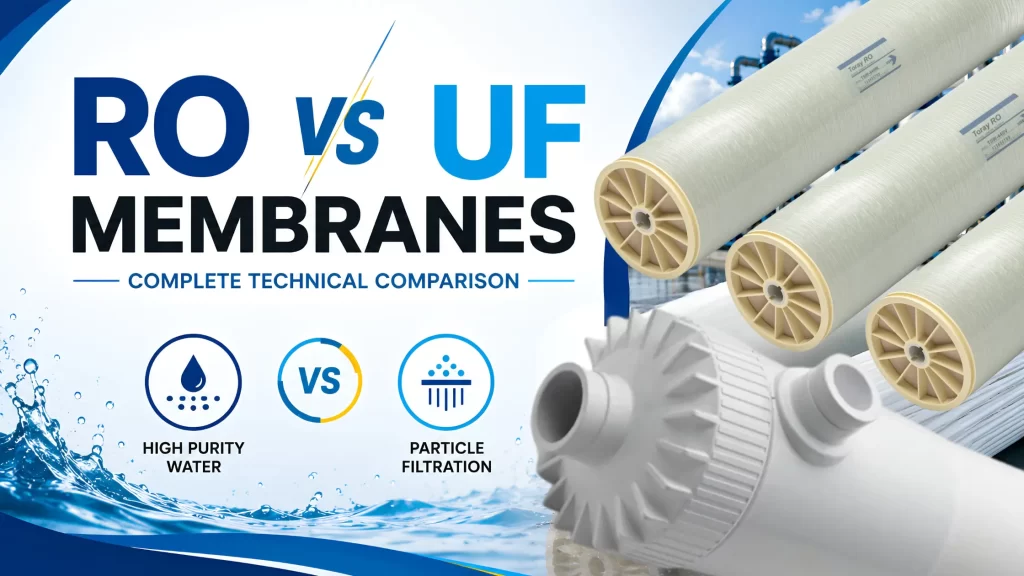
RO membranes have pore sizes of ~0.0001 µm and remove dissolved salts, heavy metals, and ions, best suited for desalination and high-purity water production. UF membranes have pore sizes of 0.01–0.1 µm and remove bacteria, viruses, and suspended solids while retaining minerals. For Indian industries, the right choice depends on your feedwater TDS, output purity needs, and energy budget.
Introduction
If you’re an EPC contractor specifying a water treatment system, or a plant engineer evaluating membrane options for a new project, you’ve probably hit this question: should we go with RO or UF membranes?
It sounds simple. It’s not.
Both are membrane-based filtration technologies. Both remove contaminants. But they work on completely different principles, handle different types of impurities, and fit different use cases. Picking the wrong one doesn’t just waste money; it can mean non-compliance with CPCB discharge norms or product quality failures downstream.
This guide breaks down the real, technical difference between RO and UF membranes with specs, industry-specific recommendations, and cost comparisons that matter for Indian industrial buyers. We’ve also included a section on why many plants actually need both to work together.
What Are RO and UF Membranes?
Let’s start with the basics without overcomplicating them.
Reverse Osmosis (RO) membranes use a semipermeable thin film composite (TFC) layer, typically made of polyamide, to separate dissolved solids at the molecular level. Water is pushed through the membrane under high pressure, and almost everything else, such as salts, heavy metals, nitrates, and organic compounds, gets rejected.
If your goal is to produce water with TDS below 10–50 ppm, RO is generally the only membrane technology that gets you there. You can read more about how they work in our complete guide to RO membranes.
Ultrafiltration (UF) membranes work differently. They use hollow fibre membranes (usually PVDF or PES material) with much larger pores. These pores are small enough to block bacteria, viruses, suspended solids, and colloids, but they let dissolved salts and minerals pass through.
Think of it this way: RO is a molecular filter. UF is a physical sieve. Both are useful, but for very different reasons. Our ultrafiltration technology guide covers UF in more depth.
How Do RO and UF Membranes Differ? (Head-to-Head Technical Comparison)
This is where most online comparisons fall short; they give you vague generalities. Here’s a proper spec-level comparison table that your engineering team can actually use.
| Parameter | RO Membrane | UF Membrane |
| Pore Size | ~0.0001 µm (0.1 nm) | 0.01–0.1 µm (10–100 nm) |
| MWCO (Molecular Weight Cut-Off) | ~100 Dalton | 500–500,000 Dalton |
| Filtration Principle | Molecular separation (diffusion + pressure) | Physical sieving (size exclusion) |
| Membrane Material | Thin Film Composite polyamide | PVDF or PES hollow fibre |
| Configuration | Spiral wound | Hollow fiber |
| Operating Pressure | 12–70 bar | 2–10 bar |
| TDS Removal | 95–99%+ | Does not remove TDS |
| Salt Rejection | >99% (varies by model) | Not applicable |
| Bacteria & Virus Removal | Yes | Yes (>4-log removal for both) |
| Suspended Solids Removal | Yes | Yes |
| Water Recovery Rate | 50–75% | >90% |
| Energy Consumption | 2–6 kWh/m³ (depends on feed salinity) | 0.1–0.5 kWh/m³ |
| Wastewater / Reject Stream | 25–50% brine/concentrate | Minimal (<10%) |
| Mineral Retention | Removes all minerals | Retains minerals |
| Typical Lifespan | 3–5 years | 3–7 years |
Sources: Energy figures for RO verified via Pumps & Systems (May 2026). Modern SWRO plants operate at 2–3 kWh/m³. UF energy figures confirmed at 0.1–0.5 kWh/m³ per Your Filter Factory (Feb 2026).
The four differences that matter most for industrial decision-making:
1. Pore size determines what gets removed
RO pores are roughly 1,000x smaller than UF pores. That’s why RO can reject dissolved salts and ions while UF cannot. If your feed water has high TDS (say, 500+ ppm) and your process needs low-TDS output, only RO does the job.
2. Operating pressure = energy cost
RO systems need 12–70 bar of pressure depending on feed water salinity. UF runs at just 2–10 bar. In practical terms, this means RO consumes 5–20x more energy per cubic meter of water produced. For large-capacity plants running 24/7, this gap adds up fast.
3. Water recovery tells you how much you waste
UF systems recover over 90% of feed water. RO systems typically recover 50–75%, with the rest going out as reject/brine. In water-scarce regions, which cover much of industrial India, this matters for both cost and compliance.
4. Mineral retention is a feature, not a limitation
UF membranes let dissolved minerals pass through. For applications where mineral content is acceptable (municipal reuse, cooling water make-up, MBR permeate polishing), UF’s mineral retention is actually an advantage; you skip the remineralisation step entirely.
Which Industries Need RO vs UF and When Do You Need Both?
Here’s what no competitor article covers: a practical, industry-wise breakdown of which membrane technology fits which application in the Indian context.
| Industry | Primary Water Challenge | Recommended Membrane | Why This Choice |
| Pharma / API Manufacturing | Ultra-pure water (WFI grade), <10 ppm TDS | RO (with UF pretreatment) | Pharmacopoeia standards demand near-zero TDS |
| Textile Dyeing & Processing | High COD, colour, dissolved salts in effluent | UF + RO (staged system) | UF removes suspended colour/SS; RO handles dissolved dye salts for reuse |
| Food & Beverage | Process water purity, pathogen-free output | RO or UF (depends on source TDS) | Low-TDS source → UF sufficient; High-TDS or borewell → RO needed |
| Power Plants | Boiler feedwater, near-zero dissolved solids | RO (mandatory) | Boiler chemistry demands <5 ppm TDS to prevent scaling |
| Chemical Processing | Specific ion and heavy metal removal | RO | Targets dissolved contaminants that UF cannot touch |
| Municipal STP Reuse | Treated effluent polishing for non-potable reuse | UF (often sufficient) | Removes residual pathogens and TSS; TDS removal not needed for reuse |
| Desalination | Seawater → freshwater conversion | RO (only viable option) | Only membrane tech that removes dissolved salts from seawater |
| EPC / Turnkey Projects | Varies by project specs and client requirements | UF + RO combination | Most ZLD/reuse projects need integrated multi-stage systems |
The India-specific angle that matters: CPCB has mandated Zero Liquid Discharge (ZLD) for textile dyeing units (above 25 KLD capacity), distilleries, pharmaceutical API plants, and certain chemical manufacturers. The textile clusters in Tirupur and Surat were among the first to face mandatory ZLD enforcement. These ZLD systems almost always require a UF + RO combination: UF for pretreatment and suspended solids removal, followed by RO for TDS reduction and water recovery before the evaporator stage.
This is driving a surge in membrane demand across India. According to IMARC Group, India’s membranes market reached USD 241.88 million in 2024 and is projected to grow at a CAGR of 8.90% through 2033. Much of this growth comes from industrial wastewater treatment and ZLD compliance projects.
Why UF Membranes Are the Best Pretreatment for RO Systems
This is where the “RO vs UF” framing breaks down because in most industrial plants, UF and RO aren’t competitors. They’re partners.
Here’s the practical reality: RO membranes are sensitive. They foul quickly when exposed to high turbidity, suspended solids, bacteria, or colloidal particles in the feed water. Fouling reduces flux, increases pressure drop, shortens membrane life, and drives up operating costs.
UF membranes solve this problem at the front end. A UF system placed before the RO unit acts as a high-performance pretreatment barrier. It consistently brings the Silt Density Index (SDI) of feed water below 3.0 and reduces turbidity to less than 0.1 NTU, both well within RO feed water requirements.
The result? Your RO membranes last longer, need fewer chemical cleans, and maintain higher flux throughout their service life.
But UF pretreatment alone isn’t enough. Even with excellent UF upstream, RO membranes still face scaling risk from dissolved minerals: calcium carbonate, calcium sulphate, silica, and barium sulphate. This is where antiscalant dosing becomes critical. A properly dosed antiscalant like ROPUR RPI prevents scale formation on the RO membrane surface, extending membrane life and maintaining recovery rates.
The ideal setup for most Indian industrial plants: UF → Antiscalant dosing → RO. This three-stage approach gives you the best combination of membrane protection, water recovery, and long-term cost control.
RO vs UF Membranes Cost Comparison for Indian Plants
Let’s talk money because for most B2B buyers, the technical specs only matter insofar as they affect the bottom line.
Capital cost (CAPEX): UF systems are generally cheaper to install. They need lower-rated pumps (2–10 bar vs 12–70 bar for RO), simpler piping, and no high-pressure housings. An RO system also typically requires pre-filtration, chemical dosing skids, and a reject handling system, all of which add to the initial investment.
Operating cost (OPEX): This is where the gap becomes significant. RO systems consume 5–20x more energy per cubic meter of treated water compared to UF. For a plant running at 100 m³/hour, the energy cost difference between RO (at ~3 kWh/m³) and UF (at ~0.3 kWh/m³) works out to roughly ₹15–20 per m³ at average Indian industrial tariffs. Over a year of 24/7 operation, that’s a difference of ₹1.3–1.7 crore in energy costs alone.
RO membranes also require more frequent chemical cleaning (CIP) and antiscalant dosing, though the right antiscalant programme actually reduces total CIP frequency and extends membrane life, offsetting a significant portion of chemical costs.
Total Cost of Ownership (TCO) over 5 years: RO costs more to own and operate. But here’s what matters: if your application demands TDS removal, there’s no cheaper alternative. UF simply cannot do what RO does. The smarter question isn’t “which costs less?” It’s “which one matches my water quality requirement at the lowest total cost?”
For applications where UF alone meets the output spec, choosing UF over RO saves 40–60% in TCO. For applications that need both (ZLD compliance, pharma, desalination), the focus should be on system integration and membrane quality to maximise recovery and minimise waste.
How to Choose Between RO and UF for Your Water Treatment Plant
We’ve seen this question hundreds of times from EPC contractors and plant engineers across India. Here’s the decision framework we use at Jay Water when consulting with clients:
Step 1: Test your feedwater TDS. If it’s above 500 ppm and your output spec requires low TDS, you need RO. If your source is municipal-treated water or low-TDS surface water, UF may be sufficient.
Step 2: Define your output purity requirement. Boiler feedwater, WFI-grade water, or product water for pharma/electronics? RO is non-negotiable. Cooling tower make-up, landscape irrigation, or toilet flushing? UF is likely enough.
Step 3: Check if pathogen removal is the primary goal. If you need to remove bacteria, viruses, and turbidity from treated STP effluent for reuse, UF handles this efficiently without the energy overhead of RO.
Step 4: Consider CPCB/SPCB compliance. If your industry falls under ZLD mandates (textiles >25 KLD, distilleries, pharma API, chemical manufacturing), you almost certainly need a UF + RO staged system.
Step 5: Evaluate your energy budget. In regions with high power tariffs or unreliable grid supply, UF’s low energy demand (0.1–0.5 kWh/m³) is a practical advantage.
If you’re still unsure, the simplest next step is to get a technical consultation. Our engineering team can review your feedwater analysis and recommend the right configuration, whether that’s standalone UF, standalone RO, or an integrated system. Talk to a technical expert →
Toray Membranes for Both RO and UF Applications
Jay Water is an authorised distributor of Toray membranes in India, covering the full range of RO, UF, NF, and MBR products. This matters for procurement because you’re dealing with a single verified source for both your RO and UF membrane requirements, backed by over 30 years of domain expertise in water treatment.
For RO applications: Toray’s TM Series elements (available in 4040 and 8040 configurations) deliver salt rejection rates above 99.7%, with low-fouling options specifically designed for industrial feed water with high organic content. These are widely used in Indian pharma, power, and desalination plants.
For UF applications: Toray’s HFU and HSU Series hollow fibre UF modules use PVDF membrane material known for its chemical resistance, high flux, and long operational life. These are ideal for RO pretreatment, MBR applications, and standalone municipal/industrial filtration. You can explore the full specs on our Toray UF membrane product page.
The advantage of sourcing both RO and UF membranes from one authorised distributor? Simplified procurement, consistent quality, and a single technical support team that understands your entire system, not just one component.
Explore our complete product catalogue or request a quote for your project requirements.
Conclusion
RO and UF membranes aren’t interchangeable, and choosing between them isn’t about which is “better.” It’s about matching the right technology to your specific water quality challenge. RO removes dissolved salts and ions. UF removes suspended solids, bacteria, and viruses. For many Indian industrial applications, especially those under CPCB ZLD mandates, you’ll need both working together in a staged system.
The key is to start with your feed water data and output requirements, not with assumptions about what your plant “should” have. Wrong membrane selection leads to wasted CAPEX, excessive energy bills, and compliance headaches.
As an authorised Toray distributor with 30+ years in industrial water treatment, Jay Water supplies both RO and UF membranes alongside ROPUR antiscalants, giving you a complete membrane protection system from a single, trusted source. Get a free consultation →

