
Quick summary: PVA gel for wastewater treatment is a polyvinyl alcohol hydrogel biocarrier that immobilises bacteria inside 4mm porous beads. It delivers up to 92% COD removal, handles 2–5 times the BOD load of conventional activated sludge, and produces 80% less excess sludge. Developed by Kuraray (Japan), it is now widely used in STPs, ETPs, and industrial plants across India.
Introduction of PVA Gel for Wastewater Treatment
Your STP tank is running at full capacity. BOD levels are climbing past discharge limits. And the obvious fix, building another clarifier, would cost crores and take months of civil work.
There is a faster, more cost-effective option. PVA gel for wastewater treatment lets you increase your plant’s treatment capacity by 2–5 times without expanding your tank volume. These small hydrogel beads, each one packed with up to 1 billion active microorganisms, do the heavy lifting of biological treatment inside your existing reactor.
At Jay Water Management, we’ve supplied and commissioned Kuraray PVA Gel across industries from dairy effluent plants in Gujarat to pharmaceutical ETPs in Maharashtra. With 30+ years in water treatment and 3,000+ clients served, we’ve seen what works and what doesn’t.
This guide covers everything an engineer, plant operator, or procurement manager needs to know about PVA gel technology: the science, the numbers, the applications, and the implementation process.
What Is PVA Gel for Wastewater Treatment?
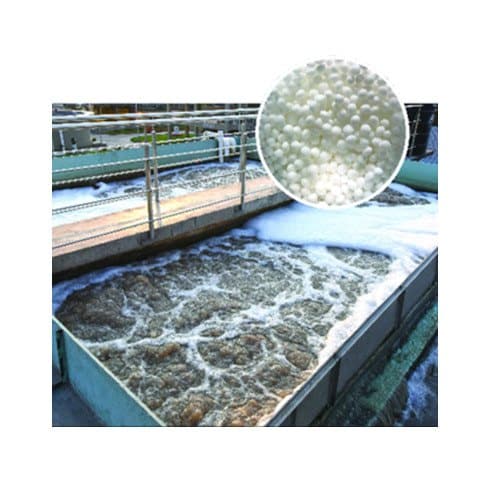
PVA gel is a porous hydrogel biocarrier made from polyvinyl alcohol. It is designed specifically for biological wastewater treatment, where it serves as a protected habitat for the bacteria that break down pollutants.
Each PVA gel bead is a 4mm sphere with a network of tiny pores (approximately 20 microns in diameter) running through its core. These pores create an enormous internal surface area, approximately 6,000 m²/m³, where beneficial bacteria colonise and multiply.
Because the microorganisms live deep inside the bead’s matrix, they are shielded from washout during high-flow conditions.
This is a major advantage over suspended-growth systems like conventional activated sludge, where bacteria are easily lost during hydraulic surges.
The material was developed by Kuraray Co., Ltd. (Japan) following more than ten years of research and development. It has been successfully used in treatment facilities across Japan for 10–15 years, consistently maintaining both its treatment efficiency and bead durability.
PVA Gel Technical Specifications
| Parameter | Value |
| Material | Polyvinyl Alcohol (PVA) Hydrogel |
| Bead Diameter | 4 mm (spherical) |
| Specific Gravity | 1.025 ± 0.01 |
| Internal Pore Size | ~20 microns |
| Water Content | 95–98% |
| Specific Surface Area | ~6,000 m²/m³ |
| BOD Loading Capacity | Up to 25–50 kg BOD/m³-gel/day |
| Nitrogen Removal Capacity | Up to 6 kg N/m³-gel/day |
| Microbial Capacity per Bead | Up to 1 billion microorganisms* |
| Operational Lifespan | 10–15 years (field-proven in Japan) |
| Chemical Resistance | Resistant to acids, alkalis, and organic solvents |
| Biodegradability | Non-biodegradable, water-insoluble |
*Depending on operating conditions. Source: Kuraray product data.
How Does PVA Gel Work in Biological Wastewater Treatment?
PVA gel works by immobilising active bacteria inside its porous bead structure. Instead of keeping microorganisms floating freely in a tank (like activated sludge does), PVA gel traps them in a stable, protected environment where they can feed on pollutants efficiently.
Here is the step-by-step process:
Step 1: Bead introduction. PVA gel beads are added directly into the aeration tank at a packing ratio of 4.8–10% of the tank volume.
Step 2: Bacterial colonisation. Within days, naturally occurring bacteria from the wastewater migrate into the bead’s 20-micron pore network and begin forming biofilms. The porous structure protects them from sloughing off during aeration.
Step 3: Pollutant degradation. The immobilised bacteria consume organic matter (BOD/COD), converting it into CO₂ and water. Simultaneously, nitrifying bacteria within the beads convert ammonia nitrogen (NH₃-N) into nitrite and then nitrate.
Step 4: Nitrogen removal. In anoxic zones, denitrifying bacteria convert nitrate back into harmless nitrogen gas (N₂), completing the nitrogen removal cycle.
Step 5: Treated water discharge. The treated water passes through a settling tank or screen, while the PVA gel beads remain in the reactor for continuous treatment.
A 2025 study published in Discover Applied Sciences (Springer) found that PVA gel beads achieved 92% COD removal efficiency in a multi-stage bioreactor setup.
The study attributed this performance to the gel’s high porosity, which supports strong microbial activity and continuous biofilm formation.
Why Immobilisation Matters?
In a conventional activated sludge system, bacteria float freely in the tank. During high-flow events or organic load spikes, these bacteria get washed out and your treatment performance drops. With PVA gel, the bacteria are physically trapped inside the bead.
They stay put, even when flows surge. That is why PVA gel-based systems can handle 2–5 times the BOD load that an equivalent activated sludge tank can manage.
What Are the Key Advantages of PVA Gel Over Conventional Treatment?
PVA gel media offer measurable, documented advantages over conventional activated sludge and standard MBBR biocarriers. These are not marketing claims; they come from pilot studies and real plant data.
1. Massively higher treatment capacity in the same tank
PVA gel’s surface area (~6,000 m²/m³) is roughly 10–12 times that of conventional MBBR carriers like Kaldnes K1 (~500 m²/m³). This means you can treat significantly more wastewater in the same reactor volume.
An India-based pilot study published in Water Science and Technology demonstrated 91% COD removal and approximately 90% ammonia-nitrogen removal using PVA gel beads in an IFAS configuration.
2. 80% less sludge production
PVA gel-based systems produce a sludge yield of about 0.10 g SS per gram of COD removed. That’s compared to 0.50 g SS/g COD for conventional activated sludge, an 80% reduction. Less sludge means lower disposal costs and fewer operational headaches.
3. Smaller footprint for new plants. Because PVA gel delivers higher treatment power per cubic metre, new plants designed with this technology require 40–60% less tank volume.
That translates directly to lower civil construction costs, less land, and faster commissioning.
4. 10 to 15-year operational lifespan. Polymerised PVA gel is water-insoluble and non-biodegradable. Facilities in Japan have been running the same PVA gel beads for over a decade with no measurable loss in treatment capacity or bead size.
5. Lower operating costs. Reduced aeration energy (because immobilised bacteria work more efficiently), combined with minimal sludge handling, means facilities often see 40–70% lower operating costs within 2–3 years.
The higher upfront cost of PVA gel is offset quickly.
PVA Gel vs Conventional Activated Sludge vs MBBR Media
| Parameter | PVA Gel | Conv. Activated Sludge | MBBR Media (K1) |
| Surface Area | ~6,000 m²/m³ | N/A (suspended) | ~500 m²/m³ |
| BOD Loading | 25–50 kg/m³/day | 0.3–0.6 kg/kg MLSS/day | 5–15 g/m²/day |
| Sludge Yield | 0.10 g SS/g COD | 0.50 g SS/g COD | 0.20–0.30 g SS/g COD |
| Biomass Retention | Very high (immobilised) | Low (free-floating) | Moderate (surface biofilm) |
| Footprint | 40–60% smaller | Baseline | 20–30% smaller |
| Lifespan | 10–15 years | N/A | 8–12 years |
| Retrofit Capability | Yes (minimal modification) | N/A (baseline system) | Yes (moderate modification) |
For a deeper look at the performance data, see our detailed advantages of Kuraray PVA Gel.
Which Industries Use PVA Gel for Wastewater Treatment?
PVA gel excels wherever wastewater has high organic loads. Here are the industries where it delivers the fastest ROI.
Municipal STP and Urban Wastewater
Sewage treatment plants treating domestic wastewater (typical BOD: 150–300 mg/L) benefit from PVA gel by upgrading existing overloaded systems without building new tanks.
The technology is particularly effective for municipalities facing rapid urbanisation where land for expansion is scarce. Read more about how PVA gel supports urban wastewater management solutions.
Dairy and Food Processing
Dairy effluent is one of the toughest challenges in wastewater treatment, with BOD levels ranging from 2,000 to 5,000 mg/L. PVA gel’s ability to handle 25 kg BOD/m³/day makes it a natural fit. Food and beverage facilities typically see the fastest return on investment because of the consistently high BOD loads and significant sludge-reduction savings.
Pharmaceutical and Petrochemical
These industries produce complex effluent streams with high COD and variable organic composition.
PVA gel’s chemical resistance (stable across a wide pH range and tolerant of solvents) and immobilised biomass ensure consistent treatment even when influent quality fluctuates.
Textile and Dye Industries
Textile wastewater contains dyes, chemicals, and high COD. PVA gel biocarriers, when combined with appropriate pre-treatment, help break down organic pollutants and meet stringent CPCB/SPCB discharge norms.
Leachate Treatment
Landfill leachate is among the most challenging wastewaters to treat, with extremely high BOD/COD, ammonia, and variable composition.
PVA gel’s high loading capacity and stable nitrification/denitrification performance make it one of the few biological solutions that can reliably handle leachate without massive tank volumes.
| Industry | Typical BOD/COD | Why PVA Gel Works | Expected Outcome |
| Municipal STP | 150–300 mg/L BOD | Capacity upgrade without new tanks | >90% BOD removal |
| Dairy/Food | 2,000–5,000 mg/L BOD | Handles extreme BOD loads | 91%+ BOD, 90%+ COD removal |
| Pharmaceutical | 1,000–3,000 mg/L COD | Chemical resistance, stable biofilm | 88–92% COD removal |
| Textile | 800–2,500 mg/L COD | Handles dyes + organic load | 85–90% COD removal |
| Leachate | 5,000–20,000+ mg/L COD | High loading + N removal | 80–89% COD removal |
How to Implement PVA Gel in Your Existing Treatment Plant?
One of PVA gel’s biggest practical advantages is that it can be retrofitted into existing activated sludge or aeration tanks. You don’t need to build new reactors. Here’s how a typical implementation works.
Step 1: Assess current plant capacity. Evaluate your existing tank volume, current BOD/COD loading, and discharge compliance gaps. Identify how much additional treatment capacity you need.
Step 2: Calculate PVA gel volume. Based on the target BOD load and tank volume, calculate the required packing ratio.
Typical installations use a 4.8–10% packing ratio (gel volume to tank volume). For example, a 250 m³ aeration tank at 10% packing = 25 m³ of PVA gel.
Step 3: Modify screening and piping. Install retention screens to keep PVA beads inside the reactor. Minor piping and pump modifications may be needed. No major civil work is required.
Step 4: Add PVA gel to existing tanks. The beads are simply added to your current aeration tank. Existing aeration equipment can usually be used without changes, though diffuser placement may need minor adjustments.
Step 5: Commission and monitor. Bacterial colonisation begins within days. Full biofilm maturation typically takes 2–4 weeks. Monitor BOD/COD, NH₃-N, and TSS levels to confirm performance targets are being met.
We’ve documented this exact process in our STP system case study using PVA Gel technology, where an overloaded plant was upgraded to handle double its original flow without any additional tank construction.
You can also see the results from a 5 KLD pilot project where PVA gel reduced BOD, COD, and TSS to within discharge limits using a compact reactor design.
Is PVA Gel Harmful to the Environment?
No. PVA gel is non-toxic, chemically inert, and does not leach harmful substances into treated water. It is made from polyvinyl alcohol, a synthetic polymer widely used in food packaging, pharmaceutical coatings, and textiles because of its safety profile.
In fact, PVA gel-based systems are better for the environment than conventional treatment in a few measurable ways. They produce 80% less excess sludge, which means significantly less waste going to landfills. They also require less aeration energy per unit of pollutant removed, which lowers the plant’s carbon footprint.
One point to consider: PVA gel is non-biodegradable. After its 10–15-year service life, the spent beads need proper disposal. A 2025 review published in the journal Environments (MDPI) noted that post-use disposal is an area in need of further development. That said, the exceptionally long lifespan means replacement is rare, and the overall waste generated over the system’s life is far less than what conventional treatment produces.
Why Choose Jay Water as Your PVA Gel Supplier in India?
Jay Water Management Pvt. Ltd. is an authorised Kuraray PVA gel distributor in India. But we are not just a supplier; we provide end-to-end technical support from system design to commissioning.
Here is what that means in practice:
•30+ years of experience in water and wastewater treatment across India
•3,000+ clients served across industrial and municipal sectors
•8 Lakh+ litres of PVA Gel installations completed
•150+ qualified professionals providing 24/7 technical support
•Complete design support: Tank sizing, air volume calculations, and process design included with every project
•Nationwide delivery with genuine Kuraray products and assured quality
Whether you need PVA gel for a new plant design or want to retrofit an overloaded ETP, we can provide customised solutions tailored to your site. Explore our full range of PVA Gel media performance data and specifications to see verified results.
Conclusion
PVA gel for wastewater treatment has moved from a niche Japanese technology to a proven, field-tested solution for industrial and municipal plants across India. The data speaks clearly: 92% COD removal, 80% less sludge, compact footprints, and a 10–15-year lifespan that makes the economics work.
If your STP or ETP is struggling with capacity limits, high sludge costs, or tightening discharge norms, PVA gel is worth evaluating. It is not the answer to every wastewater problem, but for high-BOD, space-constrained applications, nothing else comes close.
Ready to explore PVA gel for your plant? Get in touch with Jay Water Management for a free site assessment and PVA gel sizing consultation. Call us at +91 79 4846 1051–52 or request a quote here.
FAQs
What is PVA gel used for in wastewater treatment?
PVA gel is used as a biocarrier for biological wastewater treatment. It immobilises bacteria inside porous hydrogel beads to remove BOD, COD, and nitrogen from municipal and industrial wastewater. With a surface area of approximately 6,000 m²/m³, it provides far more microbial habitat than conventional MBBR media.
Is PVA gel harmful to the environment?
No. PVA gel is non-toxic and chemically inert. It does not leach harmful substances into water. It also reduces sludge production by up to 80%, which means less waste going to landfills. The only consideration is end-of-life disposal since the material is non-biodegradable, but its 10–15 year lifespan minimises replacement frequency.
How much BOD can PVA gel remove per day?
PVA gel can handle up to 25–50 kg of BOD per cubic metre of gel per day. In pilot-scale studies, it has demonstrated over 91% BOD removal efficiency, with nitrogen removal rates reaching up to 6 kg N/m³/day.
Can PVA gel be added to existing STP or ETP systems?
Yes. PVA gel is specifically designed for easy retrofit. It can be added to existing aeration tanks with minimal modifications, typically just screening, minor piping changes, and pump adjustments. No new civil construction is needed.
How long does PVA gel last in a treatment plant?
PVA gel typically lasts 10–15 years under normal operating conditions. Facilities in Japan have been running the same gel beads for over a decade with no measurable loss in treatment capacity or bead integrity. The material is non-biodegradable and chemically resistant.
What is the difference between PVA gel and MBBR media?
PVA gel has a surface area of approximately 6,000 m²/m³ compared to ~500 m²/m³ for standard MBBR carriers. PVA gel immobilises bacteria inside the bead (attached growth inside the matrix), while MBBR media supports biofilm only on the surface. This results in higher biomass retention, lower sludge production, and a smaller plant footprint with PVA gel.
Which industries benefit most from PVA gel technology?
PVA gel is most effective in dairy, food processing, pharmaceutical, petrochemical, textile, and leachate treatment, basically any application with high BOD loads. Municipal STPs also benefit when upgrading capacity without new tanks.
Who is the authorised Kuraray PVA Gel distributor in India?
Jay Water Management Pvt. Ltd. is an authorised Kuraray PVA Gel distributor in India with over 30 years of experience, 3,000+ clients, and nationwide delivery. We provide not just the product but complete design support, technical consultation, and commissioning assistance.

