
The best antiscalant for an RO system depends on your feed water chemistry, the dominant scale type, and your target recovery rate. For most industrial brackish water plants, broad-spectrum phosphino-carboxylate blends like the ROPUR RPI antiscalant series handle CaCO₃, CaSO₄, BaSO₄, silica, and iron at just 2–5 ppm dosing. But picking the wrong product? That’s an expensive mistake.
We’ve watched plants burn through membranes in under 18 months because someone grabbed the cheapest antiscalant chemical off a catalogue without running a proper water analysis first. This guide breaks down exactly how to pick the right one, the types available, how dosing works, what to monitor, and when to call for help.
If you’re looking for trusted RO antiscalant chemical suppliers in India, this article will also help you understand what separates a quality supplier from a generic reseller.
What Is an Antiscalant Chemical for RO Plants?
An antiscalant is a chemical additive injected into RO feed water before it reaches the membranes to stop mineral scale from forming on the membrane surface. Think of it as a pre-emptive shield. Without it, dissolved minerals in the water crystallise, deposit on the membrane, block pores, and choke your system.
Reverse osmosis accounts for more than 65% of the world’s desalination capacity, and antiscalant dosing is one of the most widely used pretreatment methods across these installations. It’s not optional. It’s the baseline.
How does a scale inhibitor chemical for membranes actually work? Two mechanisms:
- Threshold Inhibition: The antiscalant interferes with the nucleation process. It delays crystallisation of compounds like calcium carbonate and calcium sulfate, keeping them dissolved long enough to pass through the system in the reject stream instead of sticking to your membranes.
- Crystal Modification: Even if some crystals start forming, the antiscalant distorts their shape. Warped crystals can’t latch onto flat membrane surfaces. They stay suspended in the water and flush out with the concentrate.
The injection point matters too. Antiscalant goes in after your pretreatment (media filters, softeners, cartridge filters) but before the high-pressure pump and security filter. Getting this sequence wrong means either the antiscalant gets filtered out before it reaches the membranes or it mixes with incompatible pretreatment chemicals.
For a deeper look at how pretreatment fits together, see our guide on pretreatment for membranes to minimise scaling.
Why Does Your RO System Need an Antiscalant?
Here’s the short answer: without antiscalant, your RO membranes will scale. It’s not a question of if. It’s when.
As feed water moves through the RO system, pure water passes through the membrane while salts, minerals, and dissolved solids get left behind in the concentrate stream. The further down the system, the more concentrated these minerals become. At some point, they cross their solubility limit and start precipitating right onto your membrane surface.
The usual suspects:
- Calcium carbonate (CaCO₃): The most common scale in RO systems. Driven by pH and alkalinity. Relatively easy to clean if caught early, but forms fast.
- Calcium sulfate (CaSO₄): Harder mineral scale. Doesn’t dissolve easily in standard acid cleanings. Once it sets in, you’re in trouble.
- Barium sulfate (BaSO₄) and strontium sulfate (SrSO₄): Nearly insoluble. These are the ones that cause irreversible membrane damage. Prevention is the only real option; learning won’t save you.
- Silica: Limits recovery rates. Reactive silica polymerises on the membrane surface and forms a glassy coating that’s extremely hard to remove.
- Iron and manganese oxides: Clog pores, increase differential pressure, and accelerate biofouling.
What happens when scale takes hold?
Flux drops. Differential pressure (ΔP) climbs. Salt passage increases. Your plant starts needing chemical cleaning (CIP) every few weeks instead of every few months. According to the Hydranautics Technical Service Bulletin TSB107, an industry-standard reference acceptable CIP frequency for a well-run RO plant is once every 3 to 12 months. If you’re cleaning monthly or more, something in your pretreatment is failing.
And the cost hits hard. Individual 8040 membrane elements run anywhere from ₹15,000 to ₹45,000+ depending on brand and specification. A single large-system train might hold 50–100+ elements. Replacing an entire set because scaling went uncontrolled for a few months- that’s a bill no plant manager wants to explain.
At Jay Water, we’ve serviced 3,000+ industrial RO installations over 30 years. The single most common cause of premature membrane failure we see? Wrong antiscalant or no antiscalant at all.
What Are the Main Types of Anti-Scaling Chemicals for Industrial RO Plants?
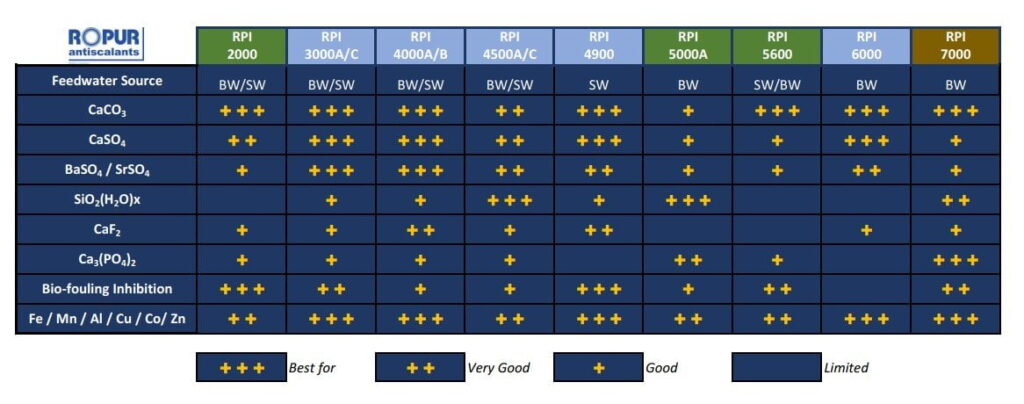
Not all antiscalants are the same. Different water chemistries need different chemistries. Here’s what’s available and what each type does best.
Phosphonate-Based Antiscalants
These use organophosphonate compounds (HEDP, ATMP, DTPMP) to block calcium carbonate crystallisation. They’re the workhorse of municipal and low-TDS brackish water applications.
Good at: CaCO₃ control. General-purpose scale prevention in moderate conditions.
Not great at: High silica or sulfate scaling. And they add phosphorus to your reject stream, a growing environmental concern, especially where discharge permits restrict nutrient loading.
Typical dosing: 2–6 ppm.
Polymer-Based Antiscalants
Built around polyacrylic acid or polymaleic acid, these target sulfate and silica scales that phosphonates miss. They’re strong dispersants, good at keeping particles suspended.
Good at: CaSO₄, BaSO₄, and high-silica waters. Broader coverage than phosphonates.
Watch out for: Overdosing in the presence of high iron can create polyacrylic acid–iron complexes that foul the membrane. Ironically, the antiscalant becomes the foulant.
Typical dosing: 2–5 ppm.
Phosphino-Carboxylate Blends (Broad-Spectrum)
These combine phosphino-carboxylic acid with polymeric dispersants to cover multiple scale types simultaneously. If your feed water has a mix of calcium, sulfate, silica, and iron, which most Indian industrial sources do, this is the category you need.
ROPUR RPI antiscalants fall into this category. They handle CaCO₃, CaSO₄, BaSO₄, SrSO₄, silica, iron, and manganese all at once.
Good at: Mixed scaling environments. Industrial brackish water. High-recovery systems.
Typical dosing: 1–8 ppm (as delivered).
Phosphorus-Free Antiscalants
Designed for applications where phosphorus discharge is regulated, such as seawater desalination, environmentally sensitive sites, and any plant under strict nutrient limits.
Good at: Seawater RO. Meeting environmental compliance.
Trade-off: Sometimes, higher dosing is needed to match the performance of phosphonate blends.
Typical dosing: 3–8 ppm.
Antiscalant Type Comparison Table
| Parameter | Phosphonate-Based | Polymer-Based | Phosphino-Carboxylate Blend | Phosphorus-Free |
| CaCO₃ Control | Strong | Moderate | Strong | Moderate |
| CaSO₄ Control | Limited | Strong | Strong | Strong |
| Silica Control | Weak | Strong | Strong | Moderate |
| Iron/Mn Dispersal | Limited | Moderate | Strong | Limited |
| Typical Dosing (ppm) | 2–6 | 2–5 | 1–8 | 3–8 |
| Phosphorus in Discharge | Yes | No | Low/None (varies) | No |
| NSF/Drinking Water Approved | Varies | Varies | Available (e.g., ROPUR RPI) | Available |
| Best For | Municipal, low-TDS brackish | High-silica groundwater | Industrial brackish, mixed feed | Seawater, discharge-sensitive |
This table gives you the starting point. But the final decision always comes back to your water analysis.
How to Choose the Right Antiscalant for Your RO Plant?
Choosing the best antiscalant for RO systems isn’t guesswork. It’s a structured process. Here’s how we approach it with our clients:
Step 1: Run a complete feedwater analysis
Test for calcium, magnesium, barium, strontium, silica (SiO₂), iron, manganese, sulfate, alkalinity, pH, temperature, and total dissolved solids (TDS). Without this data, everything that follows is a guess.
Step 2: Identify the limiting scalant
Is your water carbonate-dominant? Sulfate-heavy? High in silica? Or s is it common in Indian industrial applications a messy combination of all of them? The limiting scalant determines which antiscalant category you need.
Step 3: Match the scalant to the antiscalant category
Use the comparison table above. Carbonate-only scaling? Phosphonate works fine. Mixed scaling with silica and iron? You need a broad-spectrum blend.
Step 4: Run scaling prediction software
Tools like ROPUR’s projection software, Veolia’s Argo AAnalyser or AWC’s Proton Software model your specific water chemistry at your target recovery rate and predict exactly which scales will form and at what concentration. Don’t skip this step.
Step 5: Verify regulatory compliance
For drinking water applications, NSF/ANSI 60 certification is non-negotiable. For European markets, KIWA approval matters. For industrial wastewater RO, the requirements may be less strict, but product quality still matters.
Step 6: Confirm membrane compatibility
Make sure the antiscalant is approved for your membrane type: polyamide, cellulose acetate, or polyether. Most modern RO antiscalant chemicals are compatible with all three, but always verify with the manufacturer.
Step 7: Start at the recommended dose, then optimise
Begin dosing at the manufacturer’s recommended rate. Monitor system performance for 2–4 weeks. Adjust based on real operating data, not assumptions.
Antiscalant Dosing: Calculation, Rates & Best Practices
Getting the dosing right is where theory meets reality. Too little antiscalant and scale still forms. Too much and you waste money or, worse, the excess chemical itself contributes to fouling.
Typical Dosing Rates
For most industrial brackish water RO systems, antiscalant dosing falls between 2 and 5 ppm (mg/L of feed water). That’s the sweet spot for broad-spectrum products.
But there are exceptions:
- High-iron feedwater (>0.5 ppm Fe): Dosing may need to increase to 10–15 ppm to stabilise iron and prevent oxide deposition.
- High-silica feedwater (>40 ppm SiO₂): Silica-specific or broad-spectrum antiscalants at elevated dosing rates (5 to 8 ppm are often required.
- Seawater RO: Lower dosing (1–3 ppm) since the primary concern is usually CaSO₄ at moderate saturation.
Monthly Dosing Calculation
Here’s the formula we use with our clients:
Monthly Dose (kg) = Feed Flow (m³/h) × Dose Rate (ppm) × Operating Hours/Day × 30 ÷ 1,000
Example: A 50 m³/h brackish water RO plant running 20 hours/day at 3 ppm dosing:
50 × 3 × 20 × 30 ÷ 1,000 = 90 kg/month
Dosing Pump Sizing
Required Pump Flow (L/h) = Dose Rate (mg/L) × Feed Flow (m³/h) ÷ Solution Concentration (%) × 1.2 (safety factor)
Example: 3 mg/L dose at 50 m³/h using a 10% solution:
3 × 50 ÷ 10 × 1.2 = 18 L/h
Select a metering pump rated at or above this capacity at your system’s back-pressure.
Practical Dosing Rules
- Injection point: After pretreatment, before the cartridge/security filter. Never after the high-pressure pump.
- Dilution: If diluting, use RO permeate or deionised water. Maximum dilution is 10x (concentration must stay at or above 10%). Use diluted solutions within 48 hours.
- Tubing and fittings: Use PE, PP, or coated steel. Avoid bare metal connections; antiscalant solutions are mildly acidic (pH 1–2 for concentrates).
- Interlock the pump: Tie the dosing pump’s run signal to the RO system. When the RO stops, dosing stops. This prevents undiluted antiscalant from sitting in the feed line and potentially fouling the lead membrane.
- Calibrate weekly: Pump output drifts. A graduated cylinder and a one-minute flow test are all it takes.
Common Dosing Mistakes
Underdosing is the most common problem we see. The plant saves ₹200/day on chemicals and then spends ₹2,00,000 on a membrane replacement six months later. False economy.
Overdosing wastes money directly. With some polymer-based antiscalants, significant overdosing in high-iron water can actually create a new foulant.
Using the wrong type is the most dangerous mistake. A phosphonate-only product on a high-silica feed water gives you a false sense of security. The scaling index says you’re protected. The membrane says otherwise.
Ignoring seasonal changes catches many plants off guard. Monsoon dilutes feed water TDS and changes the ionic balance. Summer concentrates it. The antiscalant dose that worked in January may not work in July.
Why Is ROPUR RPI Antiscalant Trusted for Industrial RO Plants?
ROPUR is a brand of Toray Membrane Europe, the same company behind Toray’s globally trusted membrane technology. Jay Water is the authorised ROPUR RPI distributor in India.
Here’s why we recommend it across our client base:
Broad-spectrum performance. ROPUR RPI handles calcium carbonate, calcium sulfate, barium sulfate, strontium sulfate, calcium fluoride, silica, and iron oxides, all in a single product. For Indian feed waters, which are notoriously mixed in composition, this matters more than anything.
Verified technical specs:
- CaSO₄ saturation tolerance: up to 700%
- LSI (Langelier Saturation Index) tolerance: up to 2.8
- Dosage range: 1–8 ppm as delivered
- Compatible with polyamide and cellulose acetate membranes from Toray, DuPont, Hydranautics, LG, and other major manufacturers
Certifications that matter: NSF/ANSI 60 (drinking water treatment chemicals), KIWA (European drinking water standard), and ISO 9001/14001 production certification. These aren’t participation trophies; they represent real third-party validation.
Environmental edge: The RPI-2000 variant is phosphorus-free and rated as safe for the environment at 100x the recommended dosage. For plants operating under Zero Liquid Discharge (ZLD) mandates or tightening CPCB discharge norms, this is a genuine advantage.
With 255,500+ RO membranes installed across our client base, we’ve seen ROPUR RPI perform consistently across brackish water, surface water, and industrial wastewater applications. For documented results, see our Toray ROPUR antiscalant case study.
How to Monitor Whether Your Antiscalant Is Working?
Dosing antiscalant is only half the job. The other half is confirming it’s actually doing what it should. Too many plants set the dosing pump and forget about it for months. Then they’re surprised when membranes scale despite “proper” treatment.
Track these four KPIs:
- Normalised permeate flow: If it drops more than 10% below your startup baseline, investigate. The antiscalant may not be reaching the membranes, or the dose isn’t high enough for current water conditions.
- Normalised salt passage: A rise of more than 5% signals either scaling, fouling, or membrane damage. Don’t ignore early drift; it always gets worse.
- Stage-by-stage differential pressure (ΔP): An increase of over 15% compared to the initial commissioning value is generally recognised as the standard threshold for initiating a Clean-in-Place (CIP) procedure. A continuous upward trend also indicates that the antiscalant dosing programme should be reviewed.
- CIP frequency. Track it over time. If the interval between cleanings keeps shrinking, the antiscalant isn’t keeping up either because the dose is wrong, the product is wrong, or the feed water quality has changed.
One tip from the field: always track normalised data, not raw data. Raw permeate flow changes with feed temperature and TDS. Normalised data strips out those variables and isolates actual membrane performance. It’s the difference between seeing reality and chasing shadows.
Conclusion
Picking the best antiscalant for RO systems comes down to three things: knowing your water chemistry, matching it to the right antiscalant category, and dosing correctly. It’s not about buying the cheapest drum from the nearest supplier. One wrong decision here ripples through your entire operation: more cleaning, more downtime, shorter membrane life, higher costs.
Jay Water has been solving exactly these problems for over 30 years. With 3,000+ industrial clients and our position as India’s authorised ROPUR RPI distributor, we bring both the product range and the field experience to get your antiscalant programme right the first time.
Need help selecting the right antiscalant for your RO plant?
Contact Jay Water for a free water analysis consultation and dosing recommendation. We’ll analyse your feed water, run the scaling projection, and tell you exactly what you need no guesswork, no upselling.
FAQs
How to choose the right antiscalant?
Start with a complete feedwater analysis to identify the dominant scaling species: calcium, sulfate, silica, iron, or a mix. Match the scale type to the right antiscalant category (phosphonate, polymer, or broad-spectrum blend). For mixed scaling environments, which is what most Indian industrial plants deal with, broad-spectrum phosphino-carboxylate products like ROPUR RPI offer the widest protection at a single dosing point.
What is the typical antiscalant dosing rate for RO systems?
Most industrial RO systems dose antiscalant at 2–5 ppm (mg/L) of feed water. For high-silica or high-iron feedwater, dosing may increase to 8–15 ppm. The exact rate depends on your water chemistry, system recovery rate, and the specific antiscalant manufacturer’s guidelines. Always start at the recommended dose and adjust based on monitored performance data.
Can you use the same antiscalant for seawater and brackish water RO?
Not always. Seawater RO typically needs a phosphorus-free antiscalant designed for high-TDS, high-sulfate environments. Brackish water systems may work well with phosphonate- or polymer-based products. Some broad-spectrum antiscalants like ROPUR RPI-2000are rated for both seawater and brackish water, but the dosing rates and target scales will differ. Always confirm with the manufacturer.
How often should antiscalant dosing be checked?
Calibrate your dosing pump at least once a week using a graduated cylinder test. Review the dosing rate against updated water analysis every quarter or immediately after any major change in feed water quality. Seasonal shifts (monsoon vs. summer), source water changes, or upstream process upsets can all alter your feed water chemistry enough to throw off your dosing.
What happens if you don’t use antiscalant in an RO system?
Without antiscalant, dissolved minerals will precipitate onto the membrane surface as the concentrate stream exceeds saturation. You’ll see flux loss, rising differential pressure, and increasing salt passage. CIP frequency could jump from quarterly to weekly. In severe cases, especially with barium sulfate or strontium sulfate, the scale causes irreversible membrane damage that no amount of cleaning can fix. Prevention is always cheaper than replacement.
Which company’s antiscalant is best for industrial RO plants in India?
Look for products with NSF/ANSI 60 and KIWA certifications, proven compatibility with major membrane brands (Toray, DuPont, Hydranautics, LG), and documented performance in Indian feed water conditions. Jay Water supplies ROPUR RPI antiscalants manufactured by Toray Membrane Europe and used in thousands of installations worldwide. With 30+ years of water treatment experience and 255,500+ RO membranes in our installed base, we provide both the product and the technical support to back it up.

